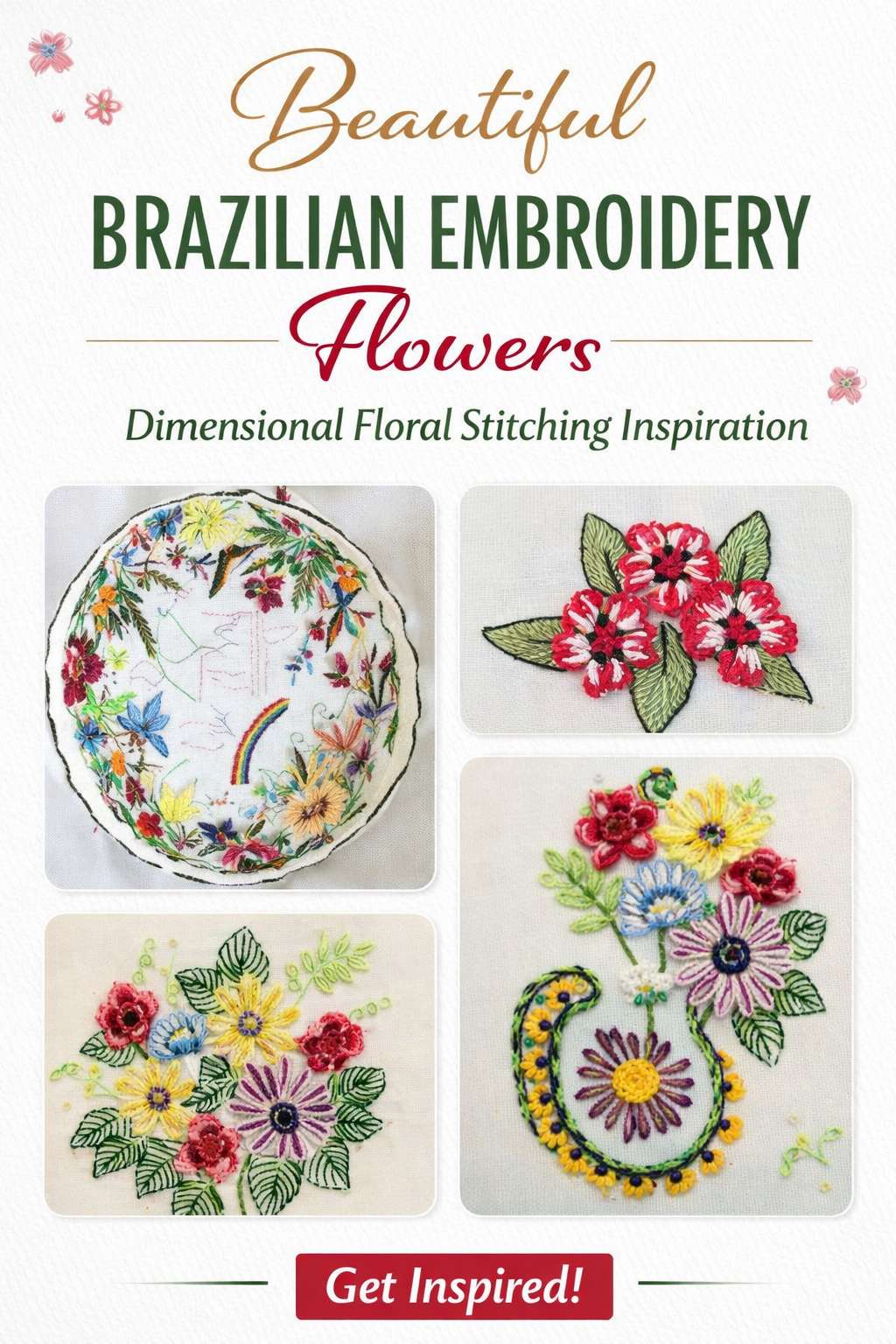
If you’ve ever looked at Brazilian embroidery and thought, well that’s a bit fancy in the best possible way, you’re not wrong. This dimensional style is all about glossy rayon thread, raised stitches, and flowers that seem to bloom right off the fabric instead of sitting flat and behaving themselves. The Brazilian Dimensional Embroidery International Guild describes Brazilian embroidery as hand stitchery worked predominantly with dimensional stitches using Z-twisted rayon threads, which is a big part of what gives it that lifted, sculptural look.
For needleworkers who love floral designs, this style is especially addictive. Petals can curl, leaves can sit proud of the fabric, and flower centres can be worked up with enough texture to make you stare at them far longer than necessary. If you enjoyed our earlier post on Brazilian embroidery inspiration, this is the natural next step, because some flowers just suit this technique beautifully. The Daisy Paisley project from the Embroiderers’ Guild of America is a good example of Brazilian embroidery being used for a floral motif stitched with rayon thread.
Why Flowers Work So Well in Brazilian Embroidery
Brazilian embroidery and flowers are a very happy match. The sheen of the rayon thread gives petals a luminous finish, while wrapped and knotted stitches create lovely depth. That means flowers can look full, layered, and wonderfully alive without needing an enormous design area. The Florists’ Cineraria feature from EGA notes that Brazilian embroidery uses rayon threads with surface embroidery stitches such as French knot, bullion stitch, and other wrapped and knotted stitches to create elegant dimensional embroidery.
It’s also a style that gives you room to be a little dramatic. And honestly, embroidery flowers should be allowed that. If you’re going to stitch a bloom, it may as well look like it has opinions.
Beautiful Brazilian Embroidery Flowers to Try
Roses
Roses are probably the most iconic flower to try in Brazilian embroidery. Bullion knots are perfect for rolled rose centres, and layered petals can give the finished flower a plump, richly dimensional look. This is the sort of flower that really shows off what Brazilian embroidery does best.
They’re a lovely choice for hoop art, hand towels, vintage linens, decorative sachets, or gift stitching. If you like your flowers classic and a bit showy, roses are very hard to beat.
Daisies
Daisies are one of the friendliest flowers to stitch if you’re newer to Brazilian embroidery. Their petal shapes are simple, cheerful, and forgiving, which makes them a nice entry point before you leap into more elaborate blooms. The Daisy Paisley project from EGA is a lovely real-world example of a Brazilian embroidery flower project stitched with rayon thread.
Daisies are especially useful in larger floral sprays too, because they work beautifully as filler flowers without looking fussy. They bring that fresh cottage-garden feel without demanding a week of your life.
Jasmines
If you’re after something a little softer and more delicate, jasmines are a beautiful flower to try. The BDEIG 2025 seminar page mentions Three Jasmines as a beginner-friendly kit, which is a very good sign that this flower shape works nicely for newer stitchers wanting to practise the basics without tackling a huge complicated bouquet.
These flowers are lovely for handkerchief corners, smaller gift projects, and daintier floral sprays. They have that graceful heirloom quality that works especially well on fine fabrics.
Clematis
Clematis is a wonderful flower to try when you want something open and garden-inspired, but still dramatic enough to show off dimensional stitching. The BDEIG seminar information mentions clematis among the flowers used in one of its designs, which tells you straight away that this flower shape translates beautifully into Brazilian embroidery.
Clematis petals give you enough space to play with texture and layering, and the finished look can feel a little looser and more natural than a tightly worked rose.
Cineraria
If you want something a bit different from the usual floral suspects, cineraria is a gorgeous choice. EGA’s Florists’ Cineraria article highlights how the design uses rayon threads and step-by-step stitch instruction, making it both pretty and practical for learning.
This is the sort of flower that gives a piece a slightly more botanical feel. It still looks lush, but it feels a touch less expected, which is always nice if you want your embroidery to stand out from the crowd.
Wildflowers and Field Flowers
Not every Brazilian embroidery design needs to be full of big formal blooms. Smaller wildflowers and field-flower styles can be absolutely beautiful in this technique too. The EGA Petite Projects page includes the BDEIG definition of Brazilian embroidery and notes that original fine growth and field flowers are encouraged, which makes wildflower-inspired motifs feel especially true to the style.
These softer floral designs work beautifully on sachets, tea towels, apron corners, and small framed pieces. They’re also ideal if you like embroidery that feels a little more natural and less arranged by committee.
Choosing the Right Flower for Your Skill Level
If you’re just beginning, daisies and jasmines are a lovely place to start. They tend to have simpler shapes and don’t require the same level of layering as roses.
If you already enjoy wrapped stitches and want to lean into texture, roses are the obvious next obsession. They show off bullions beautifully and give you that instantly recognisable Brazilian embroidery look.
If you want your stitching to feel a little different, clematis, cineraria, and wildflower motifs are wonderful options. They still have all the dimensional charm, but they feel a bit less predictable than the standard floral lineup.
Brazilian embroidery flowers have that lovely mix of pretty and impressive. They’re decorative, but they also feel a bit magical because the stitches create so much lift and texture. Even a small floral spray can look far more complex than it really is, which is always a satisfying trick in embroidery.
And once you start looking at roses, daisies, jasmines, and all those dimensional petals, it becomes very easy to start planning your next project before you’ve even finished the one in your hoop. That’s just good crafting optimism. Or poor self-control. Sometimes it’s hard to tell.
Leave a Reply