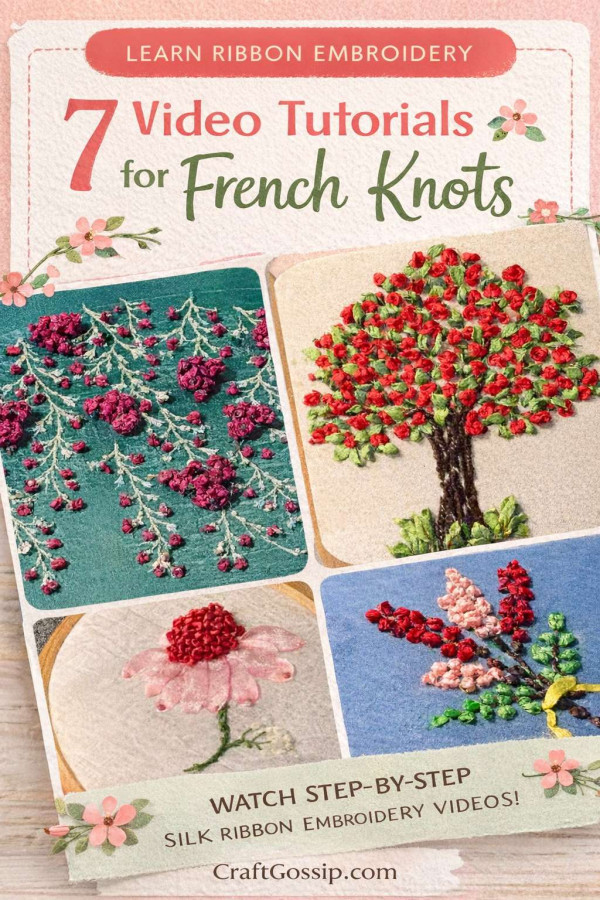
 French knots are one of those stitches that can make a ribbon embroidery project look instantly more polished. They’re tiny, textured, and surprisingly versatile, but they can also be the stitch that makes beginners want to toss the hoop across the room. If you’ve ever ended up with a twisted lump instead of a neat little knot, you’re definitely not alone.
The good news is that French knots in ribbon embroidery do get easier with practice, especially when you can watch someone actually form the stitch in real time. That’s why video tutorials are such a helpful way to learn this technique. You can see the ribbon angle, how tightly it’s wrapped, and exactly where the needle goes back into the fabric. Those little details matter more than you’d think.
This roundup pulls together a collection of video ribbon embroidery tutorials focused on French knots. Some are simple beginner lessons, some combine French knots with other basic stitches, and a few show how to turn them into actual floral motifs and textured designs. So whether you’re learning the basics or looking for a prettier way to use French knots in your next hoop project, there’s plenty here to inspire you.
Why French knots work so beautifully in ribbon embroidery
French knots are a natural fit for ribbon embroidery because they create lovely dimensional detail without needing a lot of extra stitching. In regular embroidery floss, they give you texture. In silk or satin ribbon, they give you texture and softness, which makes them perfect for flower centers, tiny buds, blossom clusters, and decorative filler.
They’re especially useful in floral ribbon embroidery, where you want a design to have a raised, almost sculpted look. A few well-placed French knots can make a flower feel finished. Scatter a cluster of them together and suddenly you’ve got blossom sprays, flowering trees, textured borders, or delicate botanical accents.
And let’s be honest, once you learn how to make a neat French knot, you start spotting places to add them everywhere.
Tips before you start stitching French knots with ribbon
Before diving into the tutorials, it helps to keep a few things in mind. Ribbon behaves differently from embroidery floss, so even if you already know how to make a French knot with thread, there can still be a bit of a learning curve.
Use ribbon that isn’t too wide for your fabric and needle size. If the ribbon is bulky, the knot can start to look clumsy rather than delicate. Keep your tension firm but not tight, because pulling too hard can flatten the knot or pull it through the fabric entirely. It also helps to avoid inserting the needle back into the exact same hole where the ribbon came out. That tiny shift makes all the difference.
Most of all, practice on scrap fabric first. French knots are one of those stitches that suddenly click after a few tries.
1. Silk ribbon french knots. Silk ribbon embroidery tutorial for beginners
This is a lovely starting point for anyone brand new to ribbon embroidery. A beginner-focused tutorial like this usually slows the process down enough for you to really see how the knot is formed, which is exactly what you want when learning a stitch that depends on hand position and ribbon control.
What makes this kind of lesson especially useful is that it strips away the overwhelm. You’re not trying to complete a whole floral design at the same time. You’re simply learning how to wrap, guide, and place the ribbon neatly so the finished knot looks intentional rather than accidental. If your ribbon stash has been sitting there looking pretty but intimidating, this is a good one to start with.
It’s also a great tutorial for stitchers who have tried French knots before and never quite felt confident with them. Sometimes a simple, beginner-level demonstration is all it takes to make a tricky stitch finally feel manageable.
2. French Knot in Silk Ribbon Embroidery
This tutorial sounds more focused and technique-driven, which is perfect when you really want to improve one stitch instead of bouncing between lots of different methods. That’s often the best way to build skill. One stitch. One motion. Repetition until it feels natural.
A dedicated French knot lesson is ideal if you want your knots to be more even and consistent. In ribbon embroidery, that matters a lot because uneven knots can change the whole look of a flower center or decorative accent. A neat knot looks elegant. A messy one can make even a pretty design feel unfinished.
This is the kind of tutorial I’d bookmark and come back to more than once. French knots aren’t hard forever, but they are definitely one of those stitches that improve with repeat watching and practice.
3. Ribbon Embroidery with Back Stitch and French Knot Stitch | Ribbon Embroidery for Beginners
I really like tutorials that pair French knots with another simple stitch because it helps you see how the knot works as part of an actual design. Back stitch is a nice partner here because it gives structure and outline, while the French knots add the decorative, raised detail.
That makes this tutorial especially helpful for beginners who are ready to move beyond isolated practice stitches and want to make something that looks like a real motif. It’s often easier to stay motivated when you’re building a little stitched element instead of just repeating knots on a practice square.
This tutorial would be especially useful for floral stems, borders, or small embellishment projects. If you enjoy embroidery that feels delicate and decorative without being overly complicated, this combination is a lovely one to try.
4. Creating a French Knot Stitch with Silk Ribbon
This sounds like another excellent fundamentals tutorial, and honestly, that overlap is a good thing. French knots can look slightly different depending on the ribbon used, the fabric tension, and the stitcher’s hand position, so seeing the method explained in more than one way can really help.
Sometimes one tutorial makes you understand the basic idea, but a second one shows the exact motion that finally makes it work for your hands. That’s especially true with ribbon embroidery, where twist, tension, and placement all affect the final result.
If your knots have been too flat, too loose, or strangely bulky, this tutorial could be the one that helps you troubleshoot what’s going wrong. It’s a good reminder that a tiny stitch can still have a technique behind it.
5. Ribbon French Knot
The short, direct title makes this sound like a quick, no-fuss tutorial, and those can be surprisingly useful. Not every lesson needs a long introduction. Sometimes you just want to see the stitch clearly and get on with your project.
This is the kind of video that’s handy once you already know the basics but need a fast refresher before starting a new hoop, embellishing a garment, or adding a few floral details to a ribbon embroidery design. It’s also useful if you’re the sort of stitcher who likes to learn by rewatching small sections over and over rather than sitting through a longer project tutorial.
There’s something to be said for a focused stitch demo that gets right to the point. French knots may be tiny, but they’re much easier when the instructions are clear.
6. Easy embroidery for beginners/ Ribbon work with French knot
This tutorial sounds especially friendly for beginners, which makes it a great pick for anyone crossing over from traditional embroidery into ribbon work. That change can feel surprisingly awkward at first. Embroidery floss behaves one way. Ribbon does its own thing entirely.
A beginner lesson like this can help bridge that gap. You get to see how ribbon moves, how to keep it from twisting too much, and how to form knots that still look soft and decorative rather than tight and forced. That softer look is part of the charm of ribbon embroidery.
This would be a nice one for relaxed afternoon stitching when you want to practice without overthinking it. Sometimes the best progress comes from a simple project and a cup of tea rather than trying to master everything at once.
7. Ribbon Embroidery French Knot Flowers Tree
This one sounds especially pretty because it takes the French knot from a practice stitch into a full decorative idea. French knot flower trees are such a lovely use of ribbon embroidery because the knots can create clusters that look like blossoms, tiny roses, or textured petals from a distance.
That makes this tutorial perfect for stitchers who want to see how French knots work in a finished design rather than just as a standalone technique. It’s one thing to learn a stitch. It’s another to understand how to use it beautifully.
Projects like this also make wonderful gifts. A floral tree stitched in ribbon can look soft, romantic, and detailed without requiring a massive complicated pattern. If you’re looking for a project that feels artistic but still approachable, this one sounds like a lovely next step.
Best ways to use French knots in ribbon embroidery projects
Once you get comfortable with the stitch, there are so many ways to use French knots in ribbon embroidery. They’re especially effective for:
Flower centers in daisies, pansies, and wildflowers
Tiny buds and blossom sprays
Textured filler in floral wreaths
Flowering tree canopies
Decorative borders on linens or keepsakes
Raised accents in botanical motifs
They also work beautifully in mixed-stitch designs where you combine ribbon roses, lazy daisies, leaves, and French knots in the same project. That contrast between flat stitched elements and raised knot detail is what gives ribbon embroidery so much charm.
Which tutorial should you start with?
If you are completely new to ribbon embroidery, start with one of the simpler beginner-focused stitch lessons first. Learn the motion, get used to the ribbon, and practice making a few neat knots on scrap fabric.
If you already know the basics and want to use the stitch in a more decorative way, the back stitch combination tutorial or the flower tree design will probably be the most satisfying. They show you how the stitch actually works inside a finished piece, which is where things start to get really fun.
And if you’re somewhere in between, that’s probably the sweet spot. Watch a technique lesson, test it out, then jump into a small motif before you lose confidence. That tends to work better than waiting until you feel completely ready.
A stitch worth learning
French knots might be small, but they do a lot of heavy lifting in ribbon embroidery. They add texture, softness, dimension, and just enough detail to make a project feel finished. Once you get the hang of them, they become one of those stitches you reach for again and again.
This collection of ribbon embroidery video tutorials is a great reminder that sometimes the best way to learn is simply to watch, pause, rewind, and stitch along. No fancy setup needed. Just ribbon, fabric, and a little patience.
If your embroidery basket is full of ribbons you’ve been meaning to use, this might be the perfect excuse to finally pull them out.
Leave a Reply