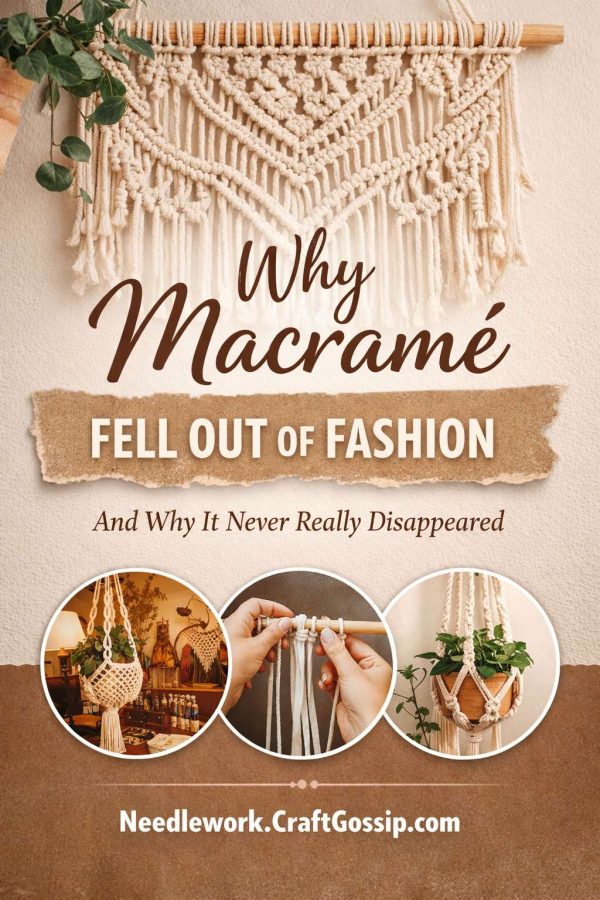
Macramé once had a moment where it felt completely unavoidable. In the 1970s, it was everywhere—plant hangers dangling in sunny windows, wall hangings covering feature walls, and chunky knotted accessories turning up in handmade markets and living rooms alike. Then, almost overnight, macramé seemed to vanish. Many crafters still ask the same question years later: why did macramé die?
The short answer is that macramé didn’t truly die—it simply fell out of fashion, much like many other craft trends before it. Craft popularity tends to move in cycles, closely tied to home décor styles, cultural shifts, and generational taste. What feels fresh and exciting in one decade can quickly start to feel dated in the next.
When Macramé Was Everywhere
Macramé’s rise was closely linked to the handmade, natural aesthetic of the 1960s and 1970s. During that time, people embraced organic materials, earthy colours, and handcrafted décor as a reaction to mass production and modernism. Knotting cord into decorative and functional pieces felt accessible, affordable, and expressive—no needles or looms required.
Because macramé was relatively easy to learn and required minimal tools, it spread quickly. When a craft becomes extremely popular, it also becomes extremely visible, which can eventually work against it.
How Trends Fall Out of Favour
Macramé’s decline wasn’t due to a flaw in the craft itself. Instead, it became a victim of overexposure. As tastes shifted in the 1980s toward sleeker lines, minimalism, and new technologies, macramé became associated with a specific era. Once a craft is strongly tied to a particular decade, it often gets labelled as “dated,” even if the techniques themselves remain timeless.
This pattern isn’t unique to macramé. Many needlework techniques—crewel embroidery, candlewicking, hardanger, even certain styles of cross stitch—have experienced similar rises and falls in popularity. Crafts don’t disappear; they simply step out of the spotlight for a while.
The Quiet Survival of Macramé
Even during its less fashionable years, macramé never completely went away. It continued quietly in craft circles, books, and small communities of makers who appreciated its structure and versatility. What changed was how visible it was in mainstream décor and magazines.
In recent years, macramé has experienced a gentle revival, often presented in softer colour palettes, modern patterns, and more minimalist designs. Today’s macramé looks different from its 1970s counterpart, but the underlying techniques are the same—proof that the craft itself was never the problem.
What Macramé Teaches Us About Craft Cycles
Macramé’s story is a useful reminder that craft trends are cyclical. A technique may fall out of favour, but that doesn’t diminish its value or creative potential. For stitchers and makers, this is reassuring. Skills learned today may feel unfashionable tomorrow, only to be rediscovered and appreciated years later.
Rather than asking why macramé died, it’s more accurate to say that it rested—waiting for a new generation to reinterpret it in their own way.
A Craft Worth Revisiting
Whether you love traditional macramé plant hangers or prefer cleaner, modern knotwork, macramé remains a flexible and expressive craft. Its temporary disappearance from the spotlight says more about changing tastes than about the craft itself.
As with embroidery, knitting, and other forms of needlework, macramé continues to evolve. Trends may come and go, but well-loved techniques have a way of returning—often when we least expect them.
It’s a veritable survey of macrame of the era. Now you’ll know why we oldsters tend to scream at the mention of that word. Go to the post.




i just like the way the brits say it.
i remember liking some macrame! 🙂
Hi, turtle! You’re right, of course. Not all macrame was as peculiar as the examples in Sister-Diane’s post. And there are some current examples that make me look forward to a revival, like this one: http://needlework.craftgossip.com/macrame-jewelry-treasure4ever/2010/05/25/. But if I never see another jute plant hanger, I’m OK with that. Just my opinion. 🙂
Denise
Awww maaaan, Now I have to find something different for your Christmas prezzie!
Those things held clay pots in my first dorm room on a multi-arm ceiling to floor plant stand. Lasted about 2 months. Plants died cause roomie and I kept knocking ’em outta the jute hangers. (We danced a lot in there.)
I adore the peculiar stuff – the more peculiar, the better. I find it all impossibly endearing in its weirdness. My favorite thing in the world is when a friend says, “I ran across this really bizarre old craft book in the thrift store the other day and immediately thought of you.”
Thanks so much for the link, Denise!
Of course you do, Diane! Because you are young and hip. Not old and crotchety like me. 🙂 I love that you find novelty and beauty everywhere you look!
Hugs,
Denise
I still macrame to this day. I have made several plant holders and alot of hanging tables. I just finished a table made with a microwave plate with a hole drilled thru the center to stablize it. I like to take stuff from around the house to make decorations to braid in the ropes. That makes each project unique in it own. Macrame tends to relax my mind and keep my hands busy. I have shown alot of my family and friend how to macrame and we all put our ideas together. I am 47 so I was very young when I learned but I still love that style.