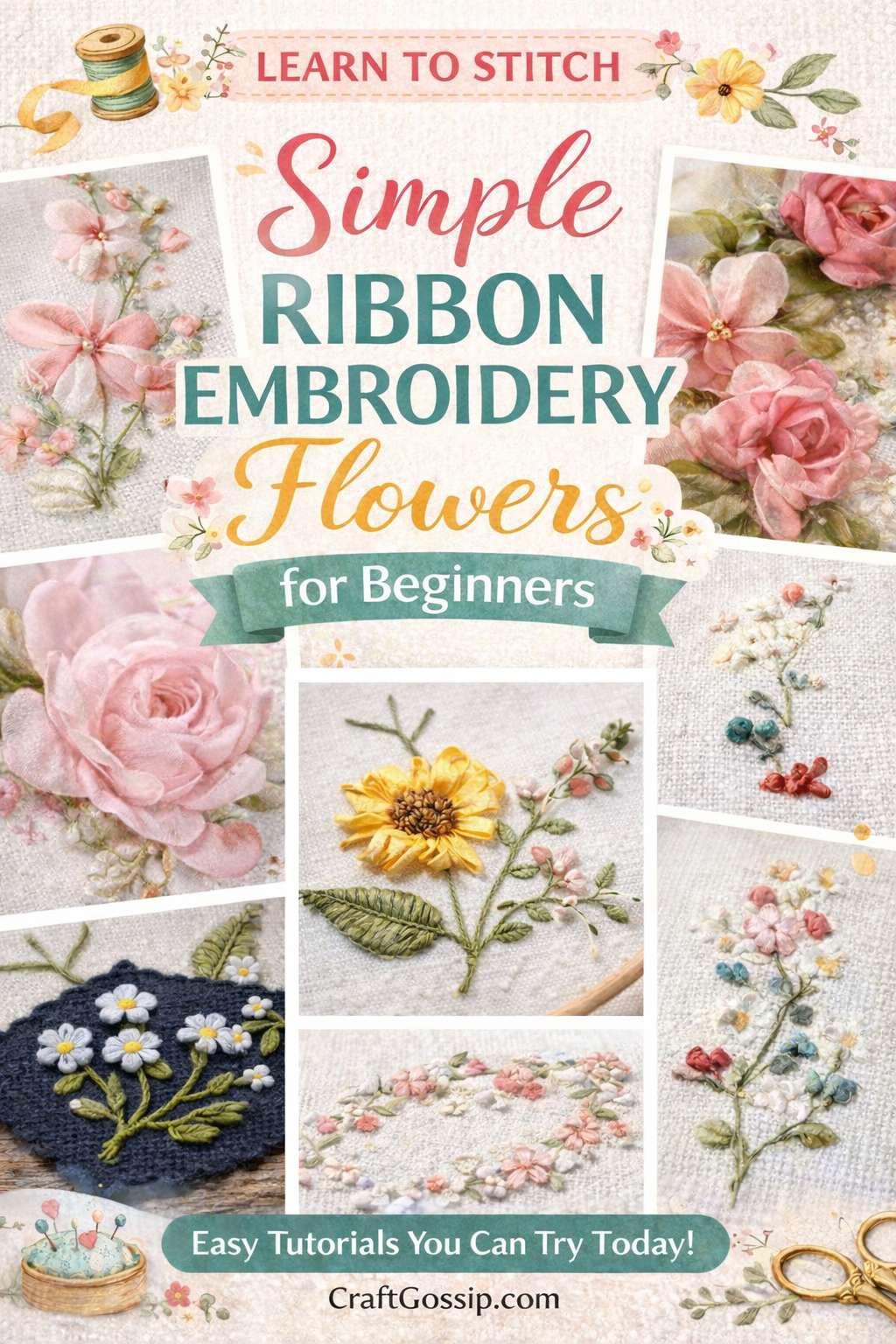
Ribbon embroidery has a way of looking far more complicated than it really is. That soft, dimensional finish can make even the simplest flower look beautifully detailed, which is exactly why it’s such a satisfying technique for beginners. And the nice part is that many starter projects rely on just a handful of basic stitches rather than a huge stitch library.
If you’ve been curious about stitching ribbon flowers but didn’t know where to start, this roundup pulls together easy tutorials, beginner stitch guides, and simple floral projects that help you learn without diving straight into the deep end. I’ve also kept the sources varied here, so the list doesn’t lean too heavily on any one site. All links below were checked live.
If you enjoy this style of dimensional floral stitching, you might also like our internal features on DIY Ribbon Embroidery Flower and 20 Tutorials For Ribbon Embroidery Roses. Both are lovely follow-on reads once you’ve tried a few basic blooms.
Ribbon embroidery for beginners
This is a great entry point if you’re completely new to ribbon embroidery and want the basics explained clearly. It’s set up to help you get used to the craft, learn enough stitches to make something pretty, and build confidence before moving into more decorative floral pieces. That makes it ideal for readers who are curious but not quite ready to tackle a full bouquet.
5 basic stitches for ribbon embroidery
This one is especially useful because it keeps the focus on the stitches that do most of the heavy lifting. It covers straight stitch, ribbon stitch, looped stitch, lazy daisy, and twisted stem, then finishes with a small practice flower. I always like tutorials that let you test the technique right away instead of leaving you with theory and no project.
A Video Tutorial for Ribbon Embroidery: Gathered Flower
If you learn better by seeing a flower come together, this gathered flower tutorial is a lovely choice. The finished bloom is made with gathered ribbon petals and a bead or French-knot center, so it gives you that soft layered floral look without needing lots of complicated stitch combinations. It’s a nice beginner project for embellishing small decorative items.
Woven Wheel Stitch Video
This is a handy option if you want to try a flower that feels a little fuller and more rose-like. The woven wheel stitch creates very effective roses with ribbon because the ribbon folds back on itself as the stitch builds up, producing those layered petal shapes that look much fancier than they really are. A good one for beginners ready to move past flat petals.
A Beginners’ Guide to Silk Ribbon Embroidery
This guide is useful because it shows just how much you can do with only five basic stitches. Threads explains that ribbon stitch, lazy daisy, straight stitch, stem stitch, and French knots can create a wide range of floral motifs, which is encouraging when you’re just starting out and don’t want to feel buried under techniques. Sometimes less really is more.
Basics of Silk-Ribbon Embroidery
This is a lovely broader beginner read if you want a feel for what ribbon embroidery can be used for beyond tiny samplers. It describes silk-ribbon embroidery as a floral, decorative hand technique often used on garments and accessories, and it has that gentle old-world feel ribbon work is so good at. It’s a nice source of encouragement for anyone still deciding whether this is a craft they want to explore further.
10 Ribbon Embroidery Flowers with silk/satin ribbons
This is one of those practical roundup-style tutorials that gives you plenty to experiment with. It covers several flower approaches, including twisted flowers, buttonhole flowers, ribbon stitch flowers, and spider web flowers, so you can try a few different looks and see which style you enjoy most. That variety makes it especially helpful for beginners building confidence.
Beginner’s Guide To Ribbon Embroidery: 9 Most Used Stitches
This is another useful basics resource because it emphasizes that ribbon embroidery relies on familiar embroidery stitches, just worked in a looser, fluffier way. That’s reassuring if you already do some regular embroidery and want to branch out without learning an entirely different craft from scratch. It’s often the ribbon itself, rather than the stitch, that creates the magic.
DIY Ribbon Embroidery Flower
This internal tutorial is a good fit for beginners because it highlights what makes ribbon embroidery so appealing in the first place: the flowers, leaves, and greenery sit up off the background fabric, giving a rich dimensional look, while the stitches themselves are uncomplicated and quick to work. That combination is exactly why so many stitchers get hooked on ribbon embroidery.
20 Tutorials For Ribbon Embroidery Roses
Once you’ve stitched a few simple flowers, this is a great next-step roundup. It leans more rose-focused than beginner-basics focused, but it’s a useful internal resource when you’re ready to move from easy flowers into more decorative floral styles. Roses are often where ribbon embroidery starts to feel especially lush and addictive.
Why ribbon embroidery works so well for beginners
The biggest reason is speed. Because ribbon has width and body, a few stitches can fill space quickly and create a dimensional result that would take much longer with regular embroidery floss. Basic stitches like ribbon stitch, lazy daisy, straight stitch, and French knots can already take you surprisingly far.
It’s also forgiving in a very charming way. A slightly twisted petal or a softly folded ribbon loop often adds to the handmade look instead of ruining it, which is honestly refreshing when you’re learning something new. That makes small flowers, simple roses, and gathered blooms especially good starting points.
A few easy beginner tips
Start with a hoop to keep your fabric firm, use a needle with an eye large enough for ribbon, and don’t pull your stitches too tight. Ribbon embroidery tends to look best when the ribbon stays soft and slightly lifted rather than flattened down. If your ribbon starts behaving like an angry shoelace, that’s usually your cue to loosen up a bit.
For first projects, try one small flower at a time rather than planning a whole floral wreath. Tulip-like shapes, simple gathered flowers, and easy ribbon-stitch petals give you a quick win and help you understand how the ribbon folds, twists, and sits on the fabric. That early success makes a huge difference.
More Needlework.CraftGossip.com inspiration
To keep readers clicking around the site naturally, these two internal links fit beautifully with this roundup:
Ribbon embroidery really is one of those crafts that rewards beginners quickly. A few soft petals, a stitched center, and suddenly you’ve got something that looks far more advanced than it felt to make — which, let’s be honest, is exactly the kind of craft confidence boost we all need sometimes.
Leave a Reply