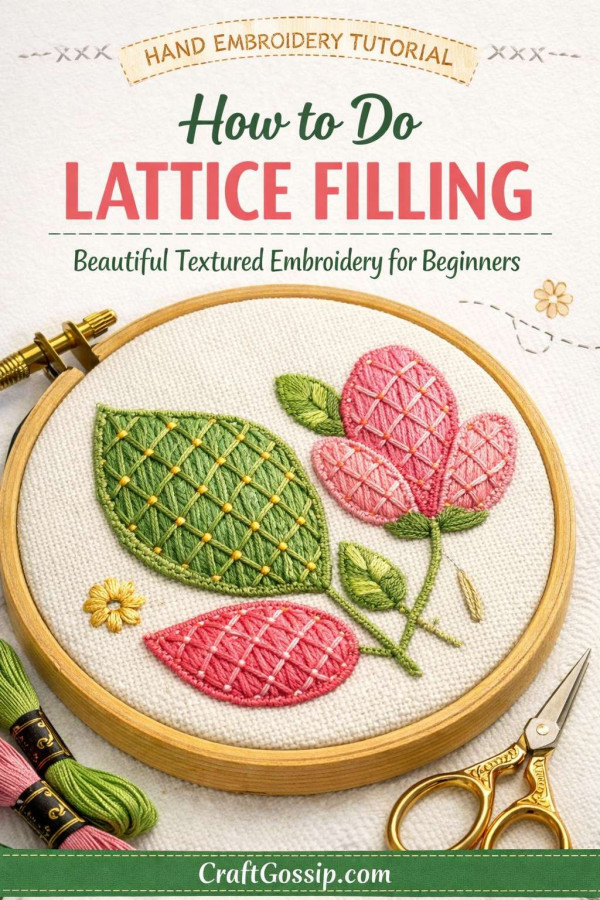
If you’ve been looking at decorative embroidery stitches and wondering how stitchers create that beautiful criss-cross filled effect inside leaves, petals, and shaped motifs, lattice filling is one of the prettiest techniques to learn.
It looks detailed and a little fancy at first glance, but once you break it down, it’s actually quite approachable. You lay one set of long threads, cross them with another set, and then secure the intersections with tiny stitches. That’s the basic idea. From there, you can keep it simple or dress it up with beads, knots, or contrasting thread. NeedlenThread describes lattice fillings as laid threads arranged into a grid with the intersections couched, and notes that people sometimes blur the line between lattice fillings and trellis-style stitches.
For beginners, this is a lovely stitch family to explore because it gives you texture without needing dense satin stitch or very advanced thread painting skills. It is one of those stitches that makes a project look impressively detailed without sending you into a full crafting tantrum halfway through.
Lattice filling is a type of laid-and-couched embroidery filling. You create a framework of long stitches across a shape, then add another layer crossing over it. After that, the intersections are secured with tiny couching stitches or decorative tie-down stitches. That open framework gives the design texture, dimension, and a lighter feel than a solid filled stitch.
This kind of filling works especially well for:
- leaves
- flower petals
- berries
- monograms
- decorative motifs
- shaped areas that need texture without bulk
If you’re still building confidence with stitch basics, it helps to first brush up on a few simple embroidery techniques. This guide to hand embroidery for absolute beginners is a good starting point, and this roundup of 9 amazing embroidery stitches for beginners gives a nice overview of foundational stitches you’ll probably use alongside lattice work.
Why Lattice Filling Is Worth Learning
One of the nicest things about lattice filling is how versatile it is. Change the spacing, direction, thread thickness, or couching stitch and you can get a completely different look. It can be delicate and airy, or richly decorative and textured. Tutorials on trellis and couched embroidery techniques also show how easily these stitches can be adapted for more dimensional work once you understand the basic framework.
It is also a handy stitch to keep in your back pocket when a plain filled area feels a bit flat. Sometimes satin stitch is perfect. Sometimes a project wants a little more personality.
If you enjoy exploring different ways to fill shapes, you might also like this post on embroidery fill stitches you should know, which is a nice companion read when deciding whether lattice filling, satin stitch, long and short stitch, or another fill is the best choice.
Supplies You’ll Need
You do not need a mountain of specialty tools for this stitch.
A simple setup is enough:
- embroidery fabric with a stable weave
- embroidery hoop or frame
- stranded cotton or perle cotton
- embroidery needle
- scissors
- water-soluble marking pen or pencil
- ruler if you want neater spacing
A taut hoop really helps here. Lattice fillings tend to behave much better when the fabric is held firmly, especially if you are trying to keep your lines evenly spaced.
How to Work a Basic Lattice Filling
Here is the simplest beginner-friendly method.
1. Mark your shape
Draw or transfer the area you want to fill. Leaves and petals are perfect practice shapes because they are small enough to manage but still show the stitch nicely.
2. Add the first layer of long stitches
Work a set of evenly spaced long stitches all in the same direction across the shape.
3. Add the second layer crossing over the first
Now stitch another set of long stitches across the first layer, creating a grid or diagonal criss-cross pattern.
4. Secure the intersections
Use tiny couching stitches, crosses, knots, or another small stitch to anchor the crossing points.
5. Tidy the edges
Make sure the filling sits neatly inside the shape. You can also outline the finished motif with stem stitch, backstitch, or split stitch if you want a cleaner edge.
That combination of laid threads plus couching is what gives lattice filling its structure. The same laid-and-held approach is also discussed in this older post on filling with laid stitches, which makes a useful follow-on read if you want to experiment with related textured fillings.
Lattice Filling vs Trellis Stitch
This is where stitch names can get a bit muddly.
People sometimes use the terms interchangeably, but they are not always exactly the same thing. Lattice filling is often used as a broader description for a grid-style filling made from laid threads and tie-down stitches. Trellis stitch, on the other hand, is often treated as a more specific stitch or variation within that same decorative family. NeedlenThread makes that distinction, and CraftGossip’s own video tutorial on couching and trellis embroidery stitches is a helpful resource if you want to see how those related techniques overlap.
If you want to explore a more decorative variation next, this older woven trellis stitch tutorial is worth a look too.
Tips for Keeping It Neat
This is the part that usually separates “ooh pretty” from “why does mine look like a tangled garden fence?”
A few simple tips help:
- keep your spacing as even as possible
- use a hoop so the fabric stays taut
- do all of one layer before starting the crossing layer
- avoid pulling too tightly
- start with a larger shape before trying tiny motifs
- mark guidelines if you need them
For newer stitchers, neatness usually improves quickly once you stop trying to wrestle the thread into submission. Gentle guidance works better than brute force. Sadly, this is also true for life.
Pretty Variations to Try
Once you know the basic version, there are lots of ways to make lattice filling more decorative:
- diagonal lattice instead of straight grid lines
- contrasting thread for the couching stitches
- French knots at the intersections
- beaded crossings
- laced lattice effects
- raised versions worked over padding
If you’re enjoying textured and dimensional embroidery, you may also like browsing broader stitch collections such as Free Book – Picture Dictionary of Hand Embroidery Stitches for more stitch-family inspiration.
Where Lattice Filling Looks Best
This stitch really shines in small decorative areas where you want texture and openness rather than a heavy solid block of stitching.
It works beautifully in:
- Jacobean-style leaves
- floral petals
- strawberries and berries
- medallions
- monograms
- decorative mending
- small ornamental motifs
It is the sort of stitch that makes people lean in for a closer look, which is always satisfying.
A Lovely Stitch for Adding Texture
Lattice filling is one of those embroidery techniques that feels a bit special without being impossibly hard. Once you understand the basic grid-and-couch method, you can adapt it in all sorts of ways to suit your style.
If you’re new to decorative fill stitches, it’s a lovely one to practice. And if you’ve already been stitching for years, it is still one of those techniques that can freshen up a familiar floral or leaf pattern beautifully.
It may look fancy, but it is surprisingly doable — and that is always my favourite kind of stitch.





Leave a Reply