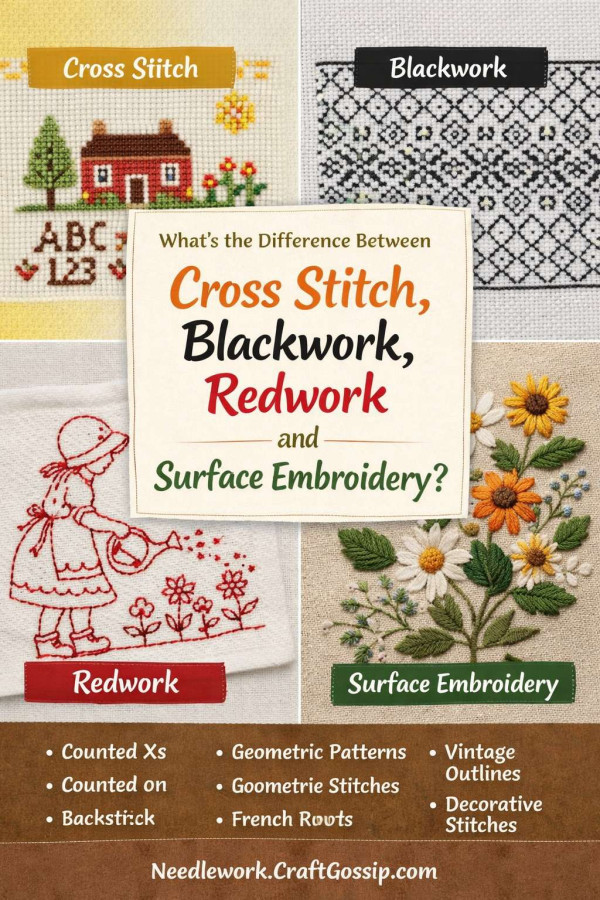
If you’ve ever wandered into the world of needlework and immediately felt like everyone else got handed a secret glossary, you’re not alone. One minute you’re admiring a pretty stitched flower or sampler, and the next you’re trying to work out whether it’s cross stitch, blackwork, redwork, or surface embroidery.
They all involve thread, fabric, and a very real chance of buying more supplies than you technically need, but they are not the same thing.
If you’re new to hand embroidery or trying to decide which needlecraft style to try first, this guide breaks down the difference between cross stitch, blackwork, redwork, and surface embroidery in plain English. No fancy waffle. Just the kind of explanation that helps you actually choose a project and get stitching.
Why these embroidery styles get confused
At a glance, all four styles can look similar to beginners because they involve decorative stitching on fabric. They’re often framed, used in samplers, turned into hoop art, or stitched for gifts and home décor.
The biggest differences usually come down to:
- the type of stitches used
- the kind of fabric you stitch on
- whether you follow a counted grid or a drawn design
- the overall look of the finished project
Once you understand those basics, it gets much easier to tell them apart.
What is cross stitch?
Cross stitch is a form of counted thread embroidery made using X-shaped stitches on evenly woven fabric.
This is often the first needlecraft style people try because it feels structured and reassuring. You work from a chart, count the squares, and place each little X in the correct spot. If you like order, repetition, and the calm feeling of filling in a design one stitch at a time, cross stitch is a lovely place to start.
How cross stitch works
In cross stitch, the fabric usually has an obvious grid. Popular fabrics include:
- Aida cloth
- evenweave
- linen for counted work
You follow a chart where each square represents one stitch. The design builds like a tiny stitched mosaic.
What cross stitch looks like
Cross stitch usually has:
- X-shaped stitches
- a pixel-like or tiled appearance
- neat blocks of color
- patterns made from charts rather than drawn outlines
Cross stitch can be modern, traditional, floral, funny, seasonal, or sampler-based. It is incredibly versatile, but the structure always comes from those counted X stitches.
Best for
Cross stitch is ideal for people who:
- like clear charts and structure
- want a portable project
- enjoy repetitive, relaxing stitching
- love samplers, quotes, motifs, and detailed pictures
If you’re looking for beginner-friendly charted projects, this style is often the easiest to understand because the pattern tells you exactly where everything goes.
What is blackwork embroidery?
Blackwork is a counted embroidery style traditionally stitched using black thread, usually in geometric, repeating, or highly patterned designs.
Blackwork often looks intricate and impressive, but it is built from simple lines and repeated motifs. Instead of filling a design with Xs like cross stitch, blackwork uses backstitch or double running stitch to create lacy-looking patterns, outlines, shading, and decorative fills.
If you’re curious about the look of modern blackwork, this would pair nicely with your related content on spring blackwork and floral blackwork charts.
How blackwork works
Blackwork can be:
- counted on evenweave or linen
- stitched from a chart
- built from repeating geometric patterns
- used for outlines and fill designs
Some blackwork patterns are very formal and symmetrical. Others are more modern and playful, with florals, animals, or seasonal motifs filled with delicate patterns.
What blackwork looks like
Blackwork usually has:
- fine lines
- repeating geometric fills
- delicate pattern texture
- mostly monochrome designs
- a light, airy, elegant look
It can look almost lace-like when stitched well, which is why so many stitchers fall in love with it.
Best for
Blackwork is great for people who:
- like detail and repetition
- enjoy geometric patterns
- want something elegant but not overly colorful
- love a traditional style with modern potential
If cross stitch feels a bit blocky to you, blackwork can be a lovely next step because it still has structure, but the finished look is lighter and more intricate.
What is redwork embroidery?
Redwork is a simple line-based embroidery style traditionally stitched in red thread using outline stitches.
This is one of the most charming and beginner-friendly styles because it usually focuses on outlines rather than dense filling. Redwork often features vintage designs, nursery motifs, kitchen themes, seasonal imagery, and old-fashioned illustrations.
Historically, it was often stitched in red floss, which is how it got its name, though modern stitchers sometimes use other colors too.
How redwork works
Redwork is usually:
- stitched on plain fabric
- transferred onto fabric first
- worked with simple outline-style stitches
- more about line drawing than filled texture
Common stitches include:
- stem stitch
- backstitch
- outline stitch
- French knots for tiny accents
If transferring a design onto fabric feels like the fiddly part, readers can jump over to How to Transfer an Embroidery Pattern Without a Fancy Printer.
What redwork looks like
Redwork usually has:
- simple outlined motifs
- minimal filling
- a vintage, nostalgic feel
- one-color stitching
- clean, storybook-style designs
It often feels sweet, traditional, and very achievable.
Best for
Redwork is perfect for people who:
- want a very beginner-friendly embroidery style
- like vintage or folk-art designs
- enjoy simple outlines more than dense stitching
- want quick projects for tea towels, pillows, blocks, or gifts
If you’re nervous about embroidery, redwork is one of the easiest styles to start with because you do not need to master lots of stitches to get a lovely result.
What is surface embroidery?
Surface embroidery is the broad category for decorative stitches worked on top of fabric using transferred or freestyle designs.
This is the most flexible and varied of the four styles. Surface embroidery includes all the decorative hand embroidery most people picture when they think of modern embroidery hoops, floral motifs, lettering, stitched leaves, textured petals, and mixed stitches.
It is less about counting squares and more about following a drawn design or creating your own.
How surface embroidery works
Surface embroidery is usually:
- stitched on plain fabric
- based on a transferred or hand-drawn pattern
- made with many different stitches
- freeform compared with counted embroidery styles
Common stitches include:
- satin stitch
- split stitch
- stem stitch
- chain stitch
- lazy daisy
- backstitch
- French knots
- long and short stitch
What surface embroidery looks like
Surface embroidery can be:
- floral
- textured
- colorful
- delicate
- modern
- whimsical
- realistic
- heavily embellished or quite simple
It is the broadest category, which is why it covers such a huge range of styles and aesthetics.
Best for
Surface embroidery suits people who:
- want more creativity and flexibility
- love floral designs and hoop art
- enjoy learning different stitches
- prefer drawn patterns over counted charts
- want to embellish clothing, linen, or gifts
If you love the idea of stitching flowers, names, leaves, insects, or decorative motifs, surface embroidery is probably what you’re looking for. For floral inspiration, a few lovely next reads are 13 Floral Hand Embroidery Tutorials, Beginner Flower Embroidery Pattern, and Floral Letter Embroidery Tutorial.
The easiest way to understand the difference
A simple way to think about it is this:
Cross stitch = counted Xs on a grid
Blackwork = counted line patterns, usually geometric or monochrome
Redwork = simple outline embroidery, traditionally in red
Surface embroidery = decorative stitches on top of fabric using transferred or freestyle designs
That’s the short version, but it helps a lot when you’re trying to sort out which patterns belong to which style.
Which embroidery style is easiest for beginners?
That depends on your personality as much as your skill level.
Choose cross stitch if:
You like structure, charts, counting, and clear instructions.
Choose blackwork if:
You like detail, repetition, elegant patterns, and a more refined monochrome look.
Choose redwork if:
You want something simple, traditional, and easy to start without learning loads of stitches.
Choose surface embroidery if:
You want freedom, color, floral projects, and lots of creative possibilities.
For many beginners, redwork and basic surface embroidery feel the most approachable because you can start with only a few stitches. Cross stitch is also beginner-friendly, especially if you prefer a more organized, chart-based craft.
What fabric does each style use?
Fabric is another clue that helps you tell these styles apart.
Cross stitch fabric
Usually stitched on:
- Aida
- evenweave
- linen with visible count
Blackwork fabric
Usually stitched on:
- evenweave
- linen
- sometimes Aida for beginners
Redwork fabric
Usually stitched on:
- cotton
- muslin
- linen
- tea towels or quilting cotton
Surface embroidery fabric
Usually stitched on:
- cotton
- linen
- blends
- felt
- clothing and accessories
- just about any fabric that suits the design
Counted styles usually need a more even weave. Drawn embroidery styles give you much more freedom with fabric choice.
What stitches are used in each type?
Here’s where the styles really separate.
Cross stitch
Main stitch:
- cross stitch
Sometimes also:
- backstitch
- fractional stitches
- French knots
Blackwork
Main stitches:
- backstitch
- double running stitch
Redwork
Main stitches:
- stem stitch
- backstitch
- outline stitch
Sometimes:
- French knots
- simple accents
Surface embroidery
Can include:
- satin stitch
- stem stitch
- split stitch
- chain stitch
- lazy daisy
- French knots
- long and short stitch
- couching
- seed stitch
Surface embroidery wins for stitch variety by a mile.
Which style is best for modern embroidery projects?
All of them can be modern, but they shine in different ways.
- Cross stitch is great for typography, funny quotes, cute motifs, and seasonal designs.
- Blackwork is perfect for sophisticated monochrome pieces, florals, and intricate fillers.
- Redwork works beautifully for vintage-inspired or farmhouse-style projects.
- Surface embroidery is the most popular for modern floral hoops, visible mending, and decorative clothing.
If you want to embellish clothes, mend a tiny hole with flowers, or stitch freestyle botanical designs, surface embroidery is usually the best fit. Posts like What is Stick and Stitch and How to Use It and Zero-Waste Embroidery: How to Use Scrap Fabric and Threads make great follow-up reads for that kind of stitching.
Can you mix embroidery styles?
Yes, absolutely.
A lot of modern needlework projects blend techniques. You might see:
- cross stitch with backstitched details
- blackwork with colored accents
- redwork mixed with simple filling
- surface embroidery combined with visible mending
- sampler pieces that use several stitch families together
Once you know the basics, mixing styles can be a lot of fun.
How to choose the right embroidery style for your next project
Ask yourself these questions:
Do I want to count stitches or follow a drawn design?
Do I like structure or flexibility?
Do I want lots of color or a simpler look?
Am I stitching hoop art, clothing, gifts, or samplers?
Do I want to learn one stitch first or experiment with many?
If you want soothing repetition, go with cross stitch or blackwork.
If you want simple vintage charm, try redwork.
If you want creative freedom, choose surface embroidery.
There is no wrong answer here, only different kinds of enjoyable thread obsession.
Why it helps to know the difference
Understanding these embroidery styles makes it much easier to:
- choose patterns you will genuinely enjoy
- buy the right fabric and supplies
- search for beginner tutorials
- avoid frustration from starting with the wrong type of project
- build confidence as a new stitcher
It also saves you from downloading a blackwork chart when what you really wanted was a floral embroidery hoop with lazy daisies and French knots.
We’ve all had craft moments like that.
More needlework inspiration for beginners
If you’re exploring different types of hand embroidery, these are great next reads:
- Hand Embroidery: 9 Amazing Embroidery Stitches for Beginners
- 13 Floral Hand Embroidery Tutorials
- Over 100 Free Hand Embroidery Patterns
- Beginner Flower Embroidery Pattern
- What is Stick and Stitch and How to Use It
- How to Transfer an Embroidery Pattern Without a Fancy Printer
A good place to start
If you are still not sure which style suits you best, start small.
Try:
- a tiny cross stitch sampler
- a simple blackwork motif
- a redwork outline design
- a floral surface embroidery hoop
One small project will tell you more than a dozen supply lists ever could.
And quite honestly, most of us end up trying all four eventually. That’s how the thread stash starts multiplying when nobody’s looking.
Leave a Reply